Design and SEO together
Every project brief includes both design goals and SEO targets from the first conversation. They’re not reconciled at the end — they’re built together from the start.
About FlintHorn
Most agencies have a design team and an SEO team that barely talk to each other. You get a site that looks great in the browser and disappears in search. FlintHorn exists because that doesn’t have to be how it works.
Three things we believe that most agencies don’t act on.
A website that looks great but ranks for nothing failed. A website that ranks well but converts nobody also failed. These aren’t separate disciplines that get handed off between teams — they’re the same question asked from different angles: how do we build something that brings the right people in and gets them to act? We’ve never separated them. Every project we take on starts with both questions on the table at the same time.

At most agencies, senior talent reviews the work. Junior talent does it. You pay senior rates and get junior output with a senior signature on it. FlintHorn is small by design — small enough that the people you talk to in the sales conversation are the people who build your site. There’s no handoff to an account manager, no brief passed to a team you’ve never met. The work is done by the same people who understood the problem.

Open-ended retainers with unclear deliverables are good for agencies and bad for clients. We scope every engagement with specific deliverables, a clear timeline, and a defined outcome. You know what you’re getting before we start. That discipline forces us to understand the problem clearly upfront — and it means you can hold us to what we said we’d deliver.

Across industries and platforms
Development and SEO
Small by design
SEO enters the brief on day one
These aren’t aspirational values on a wall. They’re the actual constraints we put on how we work.
Every project brief includes both design goals and SEO targets from the first conversation. They’re not reconciled at the end — they’re built together from the start.
The people who scope the work are the people who build it. No juniors working under a senior signature. No account managers between you and the developers.
We scope every engagement with specific deliverables and a defined timeline. You know the cost and the outcome before we start. No open-ended retainers, no scope creep.
Every site we launch has been reviewed for technical SEO before go-live — metadata, structured data, redirects, Core Web Vitals, sitemap. No exceptions.
You talk to us, not a project manager relaying messages. Decisions get made faster. Problems get caught earlier. The work is better for it.
We hand off every site with the foundation in place — Search Console configured, sitemap submitted, keyword targets documented. The launch is a starting point, not a finish line.
Two people. One shared conviction that design and SEO belong together.

Full-stack developer with 10+ years across Drupal, WordPress, GatsbyJS, Webflow, and the modern Astro + Sanity + Cloudflare stack. Built Newt, FlintHorn’s proprietary lead qualification tool.

SEO strategist who’s watched every major algorithm shift and adapted at each turn. Defines keyword targets, URL structure, and content plans before the first wireframe.
“Working with FlintHorn felt different from day one. No account managers, no handoffs — Alexander and Monty were in every conversation. They understood our business before they touched a wireframe, and the site they delivered ranks better than anything our previous agency built in two years.”
“We interviewed six agencies. FlintHorn was the only one where the people pitching were the people building. That mattered to us. The site launched on time, on budget, and our organic traffic was up 40% within three months.”
How we think about web design, SEO, and building sites that work.
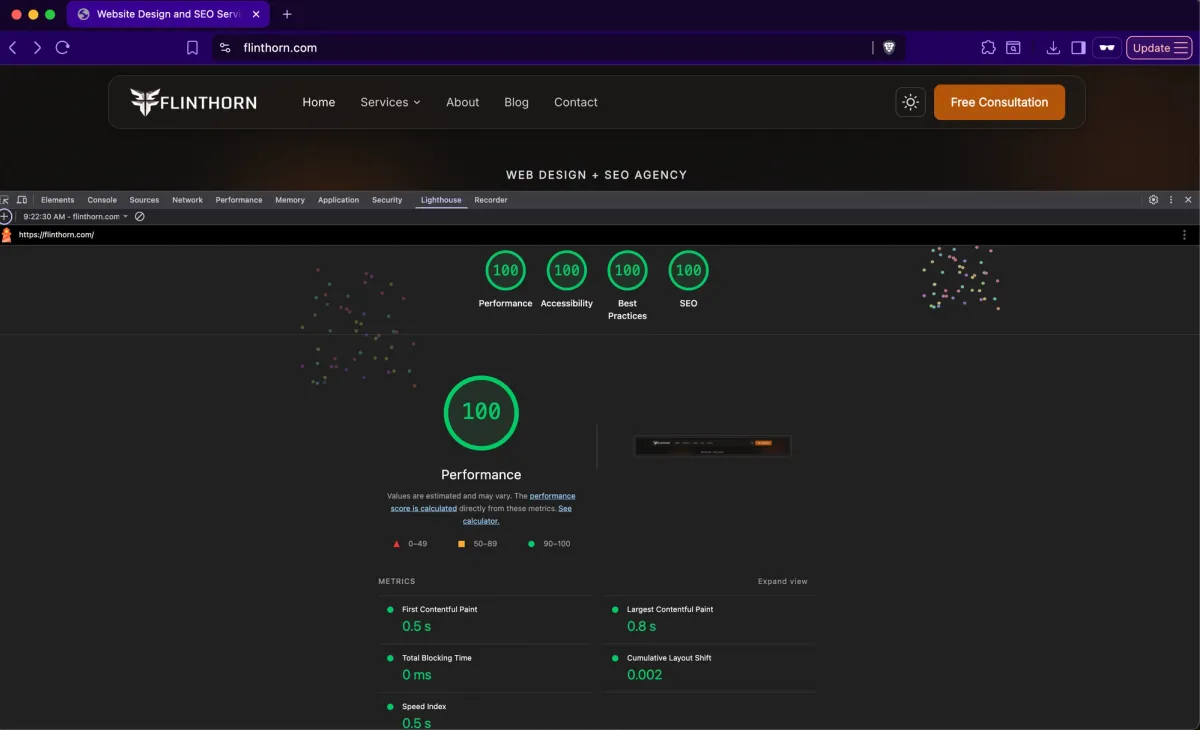
A perfect Lighthouse score isn't a vanity metric. It's a direct signal to Google that your site loads fast, works for everyone, follows best practices, and is built for search. Here's what it takes to get there — and what it means for your rankings and conversions.
Migrating off Drupal — whether to WordPress, a headless CMS, or another platform — requires careful planning to protect your content, functionality, and SEO rankings.
Is migrating from Drupal to WordPress worth it? Here’s an honest look at the benefits, the trade-offs, and how to know if it’s the right move for your organization.