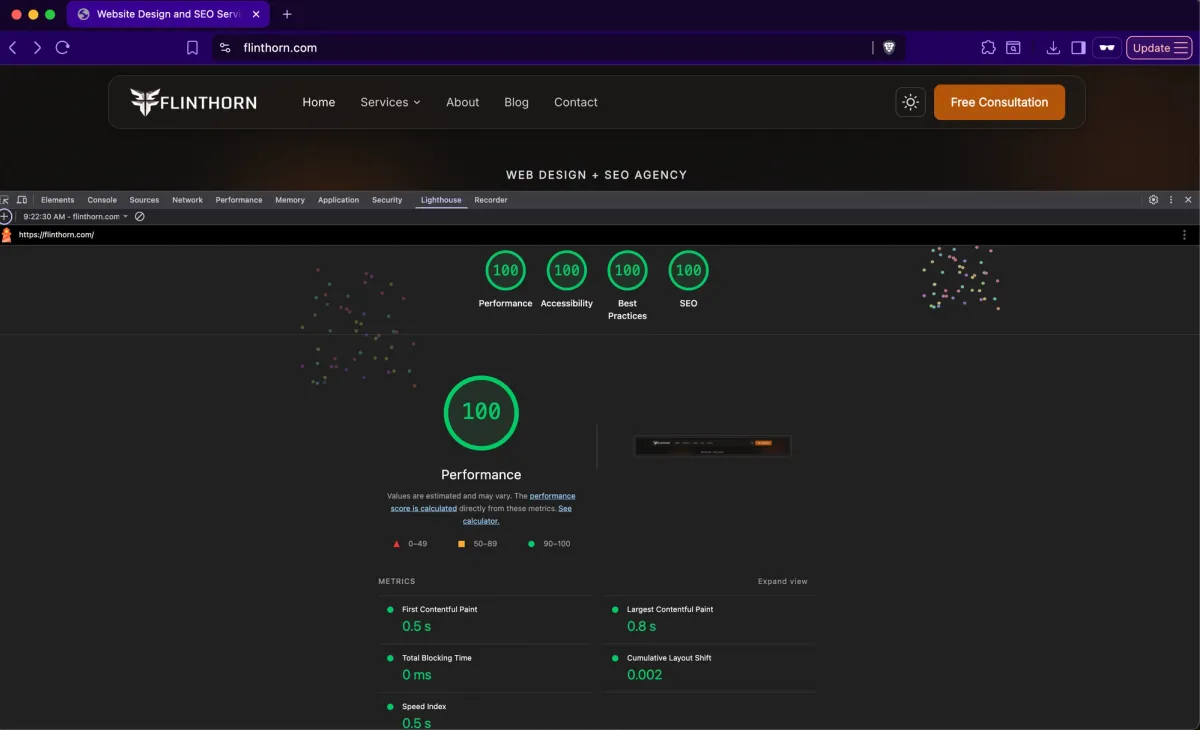
Performance-First Builds
Lighthouse 90+ scores, sub-second load times, and Core Web Vitals optimized by default — not as an afterthought after the site is built.
Web Development Services
Most web development shops build sites that work. We build sites that are fast, crawlable, and structured for search from the ground up — on a modern stack that doesn’t introduce technical debt from day one. Astro, Sanity CMS, and Cloudflare is our default. We adapt when your project calls for it.
We don’t build sites and hand them off to an SEO team. Every development decision — URL structure, heading hierarchy, structured data, page speed — is made with search performance in mind.
Lighthouse 90+ scores, sub-second load times, and Core Web Vitals optimized by default — not as an afterthought after the site is built.
Sanity CMS as the content layer, decoupled from the frontend — content editors get a clean interface, developers get full flexibility.
Deployed to Cloudflare’s global edge network — fast everywhere, not just close to a single server.
Bespoke builds on Astro, React, or Next.js when the project calls for it. We don’t force a template where a custom solution is needed.
Moving from WordPress, Drupal, or a legacy custom build to a modern stack — with SEO protection built into the migration process.
Modular, composable page-building systems in Sanity — content teams can build new pages without developer involvement.
We lead with this stack because it’s the best combination of performance, developer experience, and SEO capability we’ve found. We adapt when your project has specific requirements.
Astro is a frontend framework built around the idea that most websites ship too much JavaScript. It generates static HTML by default, hydrates interactive components only where needed, and produces some of the fastest Lighthouse scores of any modern framework. For content-driven marketing sites, it’s the right tool. We’ve been building on Astro since early in its development and know its strengths and edge cases well.
Sanity is a headless CMS with a clean, structured content model and a fully customizable editing interface. Content editors get a purpose-built experience — no unused fields, no confusing options, no broken WYSIWYG. Developers get a flexible API and a schema they control. And because the CMS is decoupled from the frontend, the presentation layer can change without disrupting the content model. We’ve built a reusable page-building system on Sanity that lets clients build new pages without touching code.

Cloudflare Pages deploys to Cloudflare’s global edge network — over 300 locations worldwide. Pages load fast regardless of where your visitor is. Cloudflare Workers extends this with serverless compute at the edge — API routes, redirects, middleware, and dynamic functionality without a traditional server. The result is a hosting setup that’s fast, resilient, and scales without infrastructure management overhead.
Our default stack is what we recommend for most new builds. But we work on WordPress, Drupal, Next.js, Webflow, and legacy custom stacks — either to migrate clients to a modern architecture or to build within an existing technical environment. We’ll tell you honestly whether your current stack is worth staying on or whether a migration to a more performant foundation makes sense for your goals.

Performance as a baseline, not a bonus
Fast everywhere, not just near a server
Clean, lean, no bloat
Across industries and platforms
From brief to launch — no black boxes, no surprises.
We start by understanding your requirements — functionality, content management needs, integrations, performance targets, and any existing technical constraints. We scope the build based on what you actually need, not a template engagement.
Before any code is written, we make the key decisions: stack, URL structure, content model, CMS schema design, third-party integrations. These decisions are documented and reviewed with you. Getting them right upfront avoids expensive changes mid-build.
We build the Sanity schema — page types, content blocks, reusable components — before frontend development begins. Content editors can start populating content while development continues, compressing the overall timeline.
Component-by-component build in Astro (or your chosen framework), with SEO considerations built into every component: semantic HTML, proper heading hierarchy, structured data, image optimization, and Core Web Vitals monitoring throughout.
Full technical audit before go-live: Lighthouse scores, Core Web Vitals, SEO metadata, structured data, redirect verification, form testing, integration testing, and cross-browser review. Issues get fixed before launch, not after.
We manage the Cloudflare deployment, DNS cutover, and post-launch verification. You receive documentation covering the CMS, deployment process, and any ongoing maintenance considerations. For sites with an existing SEO footprint, we include our standard migration monitoring for 30 days.
| Feature | FlintHorn | Typical Dev Shop |
|---|---|---|
| SEO built into development, not added after | ✓ | ✗ |
| Lighthouse 90+ scores as a baseline requirement | ✓ | – |
| Core Web Vitals monitored throughout build | ✓ | ✗ |
| Structured data implemented by default | ✓ | ✗ |
| Edge deployment on global CDN | ✓ | – |
| Headless CMS with structured content model | ✓ | – |
| Pre-launch technical SEO audit | ✓ | ✗ |
| Post-launch monitoring included | ✓ | ✗ |
“The site FlintHorn built loads in under a second. Our previous WordPress site took four seconds on a good day. The performance difference shows up in our bounce rate, our Core Web Vitals, and our rankings. Astro and Cloudflare were the right call.”
“We needed a headless CMS setup that our content team could actually use without calling a developer every time. FlintHorn built it on Sanity — our editors love the interface, and the frontend performance is the best we have ever had.”
Astro generates static HTML by default — which means faster load times, better Core Web Vitals, and fewer moving parts to secure and maintain compared to a WordPress installation. For content-driven marketing sites, it consistently outperforms traditional CMS-rendered sites on the metrics that matter for SEO and user experience. That said, we work on WordPress too — we’ll recommend what fits your project.
Yes — that’s one of the primary reasons we use Sanity. We build the CMS schema around your specific content needs, so editors see exactly the fields they need and nothing they don’t. New pages, blog posts, landing pages — all manageable without touching code. We can also build a page-building system that lets editors compose new page layouts from pre-built components.
Both. We deploy to Cloudflare Pages by default and can manage the full hosting setup — DNS, SSL, domain configuration, and deployment pipeline. For clients with existing hosting arrangements or specific infrastructure requirements, we can build to deploy to your environment.
Yes — and we handle the SEO migration process as part of the build, not as an afterthought. We audit your existing URL structure, map redirects, carry over metadata, and monitor post-launch. See our migration service for the full process.
The base engagement is complete at launch — you’re not locked into a retainer. Cloudflare Pages deployments are straightforward to maintain, and the Sanity CMS is designed for content teams to manage independently. For ongoing development work — new features, design updates, integrations — we’re available on a project basis. We’ll give you clear documentation at handoff so you’re not dependent on us for routine changes.
A standard marketing site build on our stack typically takes 8–12 weeks from discovery to launch. Larger, more complex builds with custom functionality take longer. We’ll scope the timeline based on your specific requirements and give you a milestone schedule before work begins.
What we’re writing on web development, performance, and modern stacks.
A perfect Lighthouse score isn't a vanity metric. It's a direct signal to Google that your site loads fast, works for everyone, follows best practices, and is built for search. Here's what it takes to get there — and what it means for your rankings and conversions.
Migrating off Drupal — whether to WordPress, a headless CMS, or another platform — requires careful planning to protect your content, functionality, and SEO rankings.
Is migrating from Drupal to WordPress worth it? Here’s an honest look at the benefits, the trade-offs, and how to know if it’s the right move for your organization.