Unified Design + SEO Brief
Every project starts with both design goals and SEO targets defined together. URL structure, heading hierarchy, and page intent are decided before the first wireframe.
Web Design + SEO Services
Most agencies hand these off between teams — the designers make it look good, the SEO team tries to fix what’s left. FlintHorn builds websites where design and SEO are part of the same brief, the same process, and the same outcome. Better looking and better ranking. From day one.
Performance as a baseline
SEO enters the brief on day one
Every project, no exceptions
Not after the build
Design and SEO aren’t separate line items on our proposals. They’re the same line item — because they’re the same problem.
Every project starts with both design goals and SEO targets defined together. URL structure, heading hierarchy, and page intent are decided before the first wireframe.
Semantic HTML, structured data, canonical tags, XML sitemaps, robots.txt, and Core Web Vitals — built correctly from the start, not audited and fixed after launch.
Layouts designed around how your visitors actually behave — clear hierarchy, deliberate CTAs, and visual trust signals that convert traffic into leads.
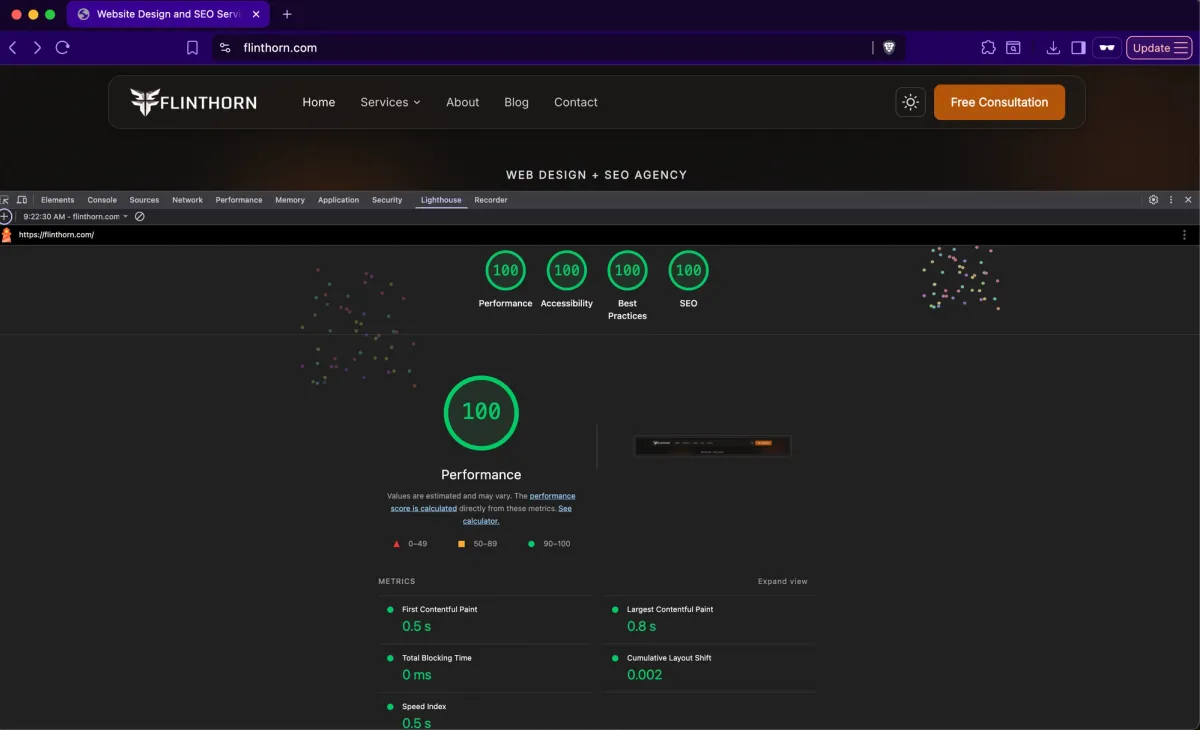
Page speed isn’t a separate optimization pass. We build fast — Lighthouse 90+ scores, optimized images, minimal JavaScript, edge deployment on Cloudflare.
Title tags, meta descriptions, heading structure, internal linking architecture, and keyword targeting — handled during the build, not retrofitted after.
We hand off every site with Google Search Console configured, sitemap submitted, and a clear picture of the keyword targets and content opportunities to pursue next.
The design-SEO split isn’t just inefficient. It actively produces worse outcomes on both sides.
The typical agency model: designers build the site, then an SEO team reviews it and adds a list of fixes. The SEO team wants to change URL structures that are already built. They want to add content the design doesn’t accommodate. They want heading hierarchy that conflicts with the visual treatment. The result is a compromise — a site that’s aesthetically weaker than it could have been and technically worse for SEO than it should have been. Both teams did their job. The outcome is still suboptimal.

URL structure, content hierarchy, page intent, internal linking — these are architectural decisions that affect both design and SEO simultaneously. When they’re made early, design can be built around them and SEO targets can be met without compromise. When they’re made late — or by a separate team after the site is built — you’re retrofitting. That’s slower, more expensive, and produces worse results than getting it right the first time.

We start every project with the same conversation: what do you want this site to rank for, and what do you want visitors to do when they get there? Those two questions shape everything — the URL structure, the page hierarchy, the content architecture, the visual layout, the CTAs. Design and SEO aren’t reviewed against each other at the end. They’re built toward the same goals from the beginning.
We hand off every site with the technical SEO foundation in place — Search Console configured, sitemap submitted, structured data verified, Core Web Vitals benchmarked. What comes next — content, backlinks, topical authority — is easier and more effective when the foundation is right. We can stay involved for ongoing SEO, or hand off cleanly to your team or another agency. Either way, you’re starting from a strong position.
Every project follows this structure. Design and SEO decisions happen together at every stage — not sequentially.
We start with two questions: what do you want this site to rank for, and what do you want visitors to do? Keyword targets, competitor analysis, current SEO baseline, and conversion goals are all established before any design work begins.
URL structure, site hierarchy, page intent, and internal linking architecture are mapped before wireframes. This is where most SEO mistakes are made or avoided — and where design and SEO need to be in the same conversation.
Wireframes and visual design developed with heading hierarchy, content structure, and conversion goals already defined. Every layout decision is connected to both the aesthetic direction and the SEO architecture. You review and approve at wireframe and design stages.
Semantic HTML, structured data, canonical tags, image optimization, page speed, Core Web Vitals — built correctly as we go, not audited after the fact. We build on Astro + Sanity + Cloudflare by default for maximum performance and SEO capability.
Before go-live: full technical SEO audit of the staging site — titles, descriptions, canonicals, structured data, sitemap, robots.txt, page speed, internal links. Everything verified before launch, not after.
Google Search Console configured, sitemap submitted, analytics verified. You receive a handoff document covering the SEO foundation, keyword targets, and content opportunities to build on. Post-launch monitoring for 30 days.
| Feature | FlintHorn | Design Agency + SEO Agency |
|---|---|---|
| SEO targets defined before wireframes | ✓ | ✗ |
| URL structure decided in architecture phase | ✓ | – |
| Heading hierarchy built into design system | ✓ | ✗ |
| Structured data implemented during build | ✓ | ✗ |
| Core Web Vitals benchmarked pre-launch | ✓ | – |
| One team accountable for both outcomes | ✓ | ✗ |
| No post-launch SEO retrofit required | ✓ | ✗ |
| Post-launch monitoring included | ✓ | – |
“Every agency we talked to had a design team and an SEO team. FlintHorn was the only one that treated them as the same thing. The site they built looks better and ranks better than anything we have had before — and it launched with SEO already working, not as a phase two project.”
“Our old site looked fine but ranked for nothing. FlintHorn rebuilt it with SEO in the architecture from the start — URL structure, heading hierarchy, structured data, page speed. Within 90 days we were ranking for keywords we had been chasing for years.”
Because they grew up as separate disciplines with separate toolsets, separate teams, and separate billing. Design agencies hired designers. SEO agencies hired keyword researchers and link builders. The problem is that the web doesn’t work that way — a site’s architecture, speed, and content structure affect both how it looks and how it ranks. Separating the two produces compromises on both sides. We never separated them.
It means SEO decisions happen at the architecture stage, not the audit stage. URL structure, page hierarchy, content intent, internal linking — these are decided before the first wireframe. Heading structure is designed into the layout system. Technical SEO requirements (structured data, canonical tags, sitemap structure) are part of the development spec. You don’t get an SEO audit after launch — you get a site that was built correctly from the start.
Yes — and protecting your existing SEO equity is a core part of how we approach redesigns. We audit your current rankings, top-performing pages, and URL structure before any design work begins. Everything worth protecting gets carried over. See our redesign service for the full process.
Astro + Sanity CMS + Cloudflare Pages is our default stack — optimized for performance, SEO, and content management flexibility. We also build on WordPress and can work within your existing platform if you have one. See our web development service for more on the technical side.
Yes — we can stay involved for ongoing SEO work including content strategy, LLM and AI SEO optimization, and technical SEO maintenance. We can also hand off cleanly to your internal team or another agency. Either way, you’re starting from a properly built foundation. See our LLM & AI SEO service
Typically 8–12 weeks for a full new build. The discovery and architecture phase takes longer than a pure design project because we’re establishing both the visual direction and the SEO architecture before any build work begins — but that investment upfront saves time and cost later.
What we’re writing on web design, SEO, and how they work together.
A perfect Lighthouse score isn't a vanity metric. It's a direct signal to Google that your site loads fast, works for everyone, follows best practices, and is built for search. Here's what it takes to get there — and what it means for your rankings and conversions.
Migrating off Drupal — whether to WordPress, a headless CMS, or another platform — requires careful planning to protect your content, functionality, and SEO rankings.
Is migrating from Drupal to WordPress worth it? Here’s an honest look at the benefits, the trade-offs, and how to know if it’s the right move for your organization.